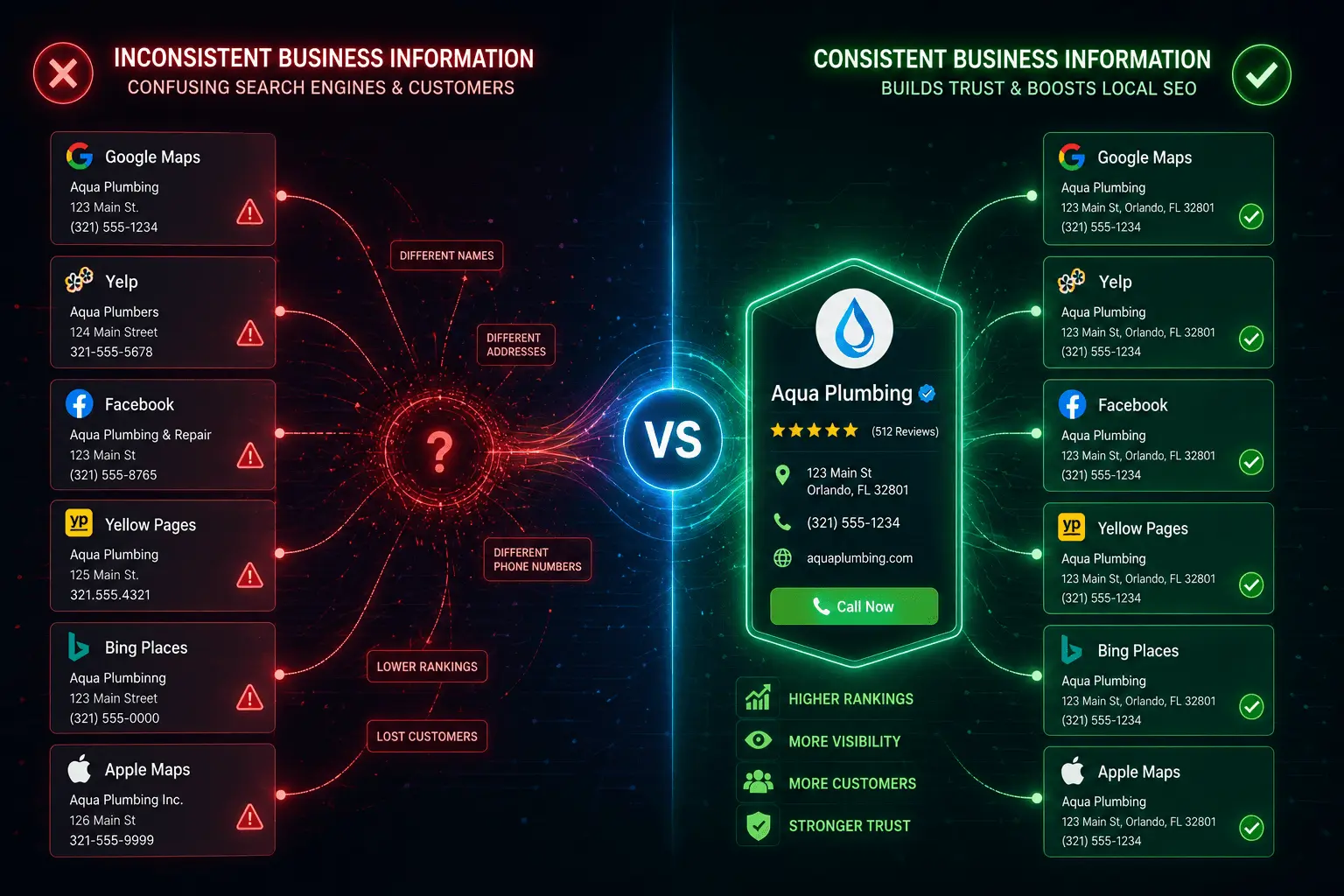
That is what NAP inconsistency does. It quietly destroys your local rankings while you keep spending money on things that are not the real problem.
What Does NAP Actually Mean in Local SEO?
NAP stands for Name, Address, and Phone Number — the three pieces of information that represent your business identity across the web. Every time your business appears on Yelp, Yellow Pages, Bing Places, or any directory, those details form what SEO professionals call a citation.
Google uses citations to verify that your business is real, consistent, and trustworthy. When everything matches, Google interprets that as a signal of authority. When information conflicts, Google reduces your local ranking potential because it cannot confidently present your business to searchers.
Google does not always know which version of your business information is correct. If your address shows 'Suite 200' on Google but 'Ste 200' on 30 other directories, that looks like a discrepancy. Google does not guess. It simply trusts you less.
Why Google Treats NAP Consistency Like a Background Check
Google's local algorithm relies on data from multiple sources to verify business legitimacy. It does not just look at your Google Business Profile — it crawls directories, aggregators, social platforms, and third-party databases to cross-reference your information.
In almost every case where a business struggles to break into the local 3-pack, NAP inconsistency is a major contributing factor. Not always the only factor, but rarely absent.
The Most Common NAP Mistakes That Tank Local Rankings
Abbreviation inconsistency
"Street" vs "St." or "Avenue" vs "Ave." — To a search engine processing structured data, these are discrepancies.
Multiple phone numbers
Businesses that run a tracking number for ads alongside their main number often list both in different places. Google may interpret different phone numbers as different business entities.
Old locations
A business moves, updates Google Business Profile, and forgets the 60 other directories where the old address still lives.
Inconsistent business names
"Johnson Plumbing LLC" vs "Johnson Plumbing" vs "Johnson Plumbing Austin" — each variation creates confusion in Google's local data ecosystem.
Aggregator errors multiplying
Platforms like Data Axle and Neustar Localeze push your business information to hundreds of downstream directories. Errors at the aggregator level multiply across the entire citation ecosystem.
How to Audit Your NAP Data Right Now
Define your master NAP
Write down the exact, official version of your business name, address, and phone number. This is your source of truth. Every listing must match this exactly.
Search Google for your business name + city
Look at every listing that appears. Check the NAP on each one against your master version. Note every discrepancy, no matter how small.
Search for your phone number in quotes
You will find directories that have listed your number — sometimes with incorrect names or addresses attached.
Use a tool for a comprehensive scan
BrightLocal, Moz Local, or Whitespark scan major directories and compare what they find against your master NAP, giving you a clear inconsistency report.
Build a priority spreadsheet
List every directory, the current NAP it shows, and whether it matches. Prioritise by domain authority — Google Business Profile, Yelp, Bing Places, Apple Maps, and Facebook first.
The Tools That Actually Fix NAP Problems
- BrightLocal — Best overall for thorough citation management. ~$29/month. Transparent reporting.
- Moz Local — Solid for straightforward solutions. Pushes corrected NAP to major aggregators. ~$14/month.
- Yext — Premium option with real-time control over 200+ platforms. ~$199+/year. Best for multi-location businesses.
- Whitespark — Strong for manual citation building in competitive local markets.
For small local businesses just getting started, fix the top 20 directories manually before investing in any subscription tool. Get your core citations right first, then use tools for monitoring.
How Long Does NAP Consistency Take to Impact Rankings?
Expect a 3 to 6 month timeline to see meaningful ranking movement. Google re-crawls directories on different schedules — some weekly, some every few months. When you correct a citation today, Google may not notice that correction for weeks.
A home services company in Phoenix completed a full NAP cleanup in January. By April, they had moved from position eight in local search to the 3-pack for three primary service keywords. Revenue from organic local search increased 34% that quarter.
NAP and Your Website: The Connection Most Businesses Miss
Your website's contact page, footer, and schema markup should all display your master NAP exactly. Google compares what it finds on your website against your GBP and other citations. A mismatch between your website and your GBP is a trust signal problem that holds back your local rankings.
Add LocalBusiness schema markup to your website. This structured data format tells Google exactly what your business name, address, phone number, and hours are in machine-readable language.
Frequently Asked Questions About NAP in SEO
Yes, significantly. Google uses citations to confirm business legitimacy. Inconsistent NAP data creates conflicting signals that reduce your ranking potential in local search, including the Google 3-pack.
Quality matters more than quantity. Having 50 accurate, high-authority citations outperforms having 300 inconsistent ones. Focus on the top 20–30 directories in your industry and region before chasing volume.
Update your Google Business Profile immediately. Then systematically update every directory where your old address appears. Set a quarterly reminder to check for directories still showing the old location.
Yes. Facebook, LinkedIn, Instagram business profiles, and X business accounts all count as citation sources. Make sure your NAP on these platforms matches your master NAP exactly.
A citation audit is a systematic review of all online mentions of your business to check whether your NAP is accurate and consistent everywhere. It is the essential first step of any serious local SEO cleanup effort.
Want These Results for Your Business?
Get a free local SEO audit — I'll show you exactly what's holding your rankings back and the fastest path to the Map Pack.
🎯 Get Your Free SEO Audit