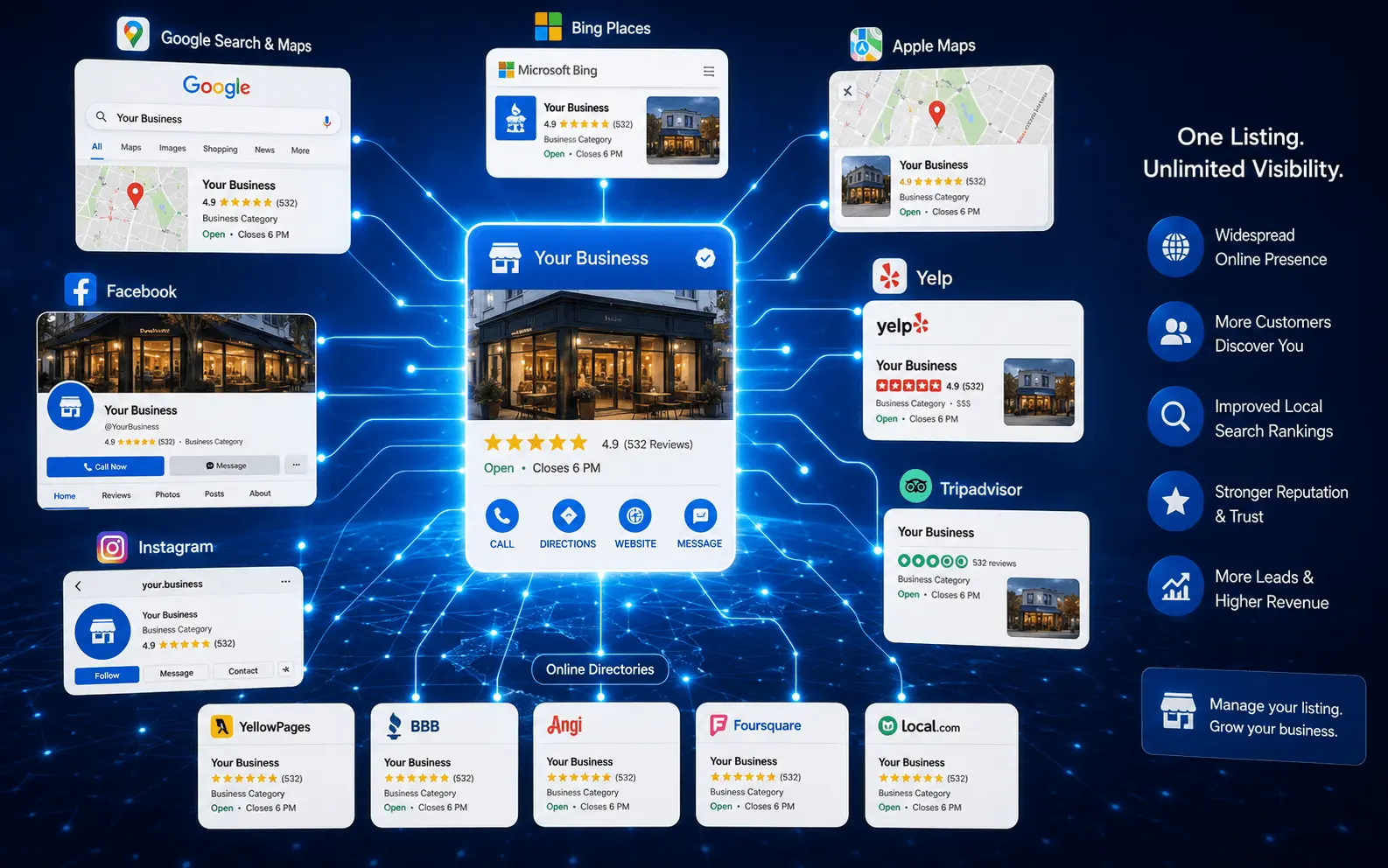
What Local Citations Actually Are and Why They Matter
A local citation is any online mention of your business name, address, and phone number. This combination is commonly referred to as NAP data. A citation can appear on a general business directory like Yelp or Yellow Pages, an industry-specific platform like Houzz for contractors or Healthgrades for medical practices, a local Chamber of Commerce website, a news article that mentions your address, or a sponsorship listing on a community organisation's site.
Citations matter to Google for one fundamental reason: Google cannot physically visit your business to verify it exists. Instead, it relies on the web as a verification layer. When Google sees your business name, address, and phone number appearing consistently across dozens of credible sources, it gains confidence that your business is real and located where you claim. That confidence translates directly into higher local search rankings.
⚠️ Inconsistent citations are actively harmful. When your citation data contains different phone numbers, old addresses, or varied business name spellings, Google treats that as a reliability signal — reducing its confidence in your business overall and ranking you lower as a result.
The Difference Between Structured and Unstructured Citations
Structured citations
Formal business listings on dedicated directories — Yelp, Angi, Bing Places, Apple Maps, Facebook Business, TripAdvisor. Google indexes these heavily because the data is clean, consistently formatted, and specifically structured as business information.
Unstructured citations
Mentions of your business in non-directory contexts — a local newspaper article mentioning your address, a blog post reviewing your services with your phone number, a community forum recommendation. These carry strong authority signals because they represent genuine, organic references from real content.
Structured directories build your baseline verification layer. Unstructured mentions build the kind of community-embedded authority that tells Google your business is genuinely woven into the fabric of your local area.
Why Citation Consistency Is More Important Than Citation Volume
Business owners read that citations improve local rankings, so they rush to submit their information to as many directories as possible. The result is often worse than doing nothing.
Every time you submit to a new directory, that listing becomes a permanent data point Google indexes. If your business has ever changed its address, phone number, or business name, every new submission replicates the confusion rather than correcting it. A business that submits to 200 directories with inconsistent data has not built authority. It has built a maze Google cannot navigate reliably.
Audit first, build second
Before creating a single new citation, know exactly what information exists about your business across the web. Tools like BrightLocal, Whitespark, and Moz Local will scan the major directories and show every inconsistency. The audit takes 20 to 30 minutes and consistently reveals problems business owners had no idea existed.
Fix every inconsistency before building
Your business name should appear identically everywhere. "Teresa Chen Accounting" and "Teresa Chen Accounting LLC" and "T. Chen Accounting" are three different entities to an algorithm. Pick one version and make it uniform across every listing.
The Citation Sources That Actually Influence Rankings
- Tier 1 (highest authority): Google Business Profile, Yelp, Bing Places, Apple Maps, Facebook Business, Better Business Bureau, Foursquare, Yellow Pages. Non-negotiable — getting these right is your foundation.
- Tier 2 (industry relevance): Avvo/FindLaw for legal, Healthgrades/Zocdoc for medical, Angi/Houzz/HomeAdvisor for contractors, TripAdvisor/OpenTable for restaurants. Contextually appropriate citations carry extra relevance signals.
- Tier 3 (geographic relevance): City Chamber of Commerce, local business association directories, regional news sites, community organisation sponsorship pages. Strong geographic relevance signals valuable for local market competition.
How to Build Citations That Compound in Authority Over Time
- Start with every Tier 1 source and complete every field — hours, categories, description, website, photos, and services where applicable
- Research which Tier 2 directories are specific to your trade or profession — a dentist in Austin should prioritize Healthgrades, Zocdoc, and the American Dental Association directory
- Build local Tier 3 citations last — local Chamber of Commerce, relevant business associations, and local directories specific to your area
- Review core listings every six months and update within the same week whenever your address, phone, or hours change
Common Citation Mistakes That Suppress Local Rankings
Different business name formats
Always use your exact registered trading name identically everywhere. No abbreviations, no additions, no variations.
P.O. Box or virtual office address
Google needs to see the same physical address consistently across every source. Virtual addresses should never appear as your primary business address on citation sources.
Ignoring duplicate listings
When a business moves or rebrands, old listings frequently remain active. Multiple active listings for the same business at different addresses are among the most damaging citation patterns Google encounters.
Leaving listings incomplete
A directory listing with just your business name and phone number carries less authority than a fully completed listing with descriptions, categories, hours, website, and photos. Fill every field every time.
Frequently Asked Questions
There is no magic number. In smaller markets, 30 to 40 high-quality, consistent citations on the right sources can support strong Map Pack rankings. In major metro areas, top-ranked businesses typically have 60 to 100 or more citations across all three tiers. Quality and consistency matter more than volume.
Most citation changes take four to eight weeks to propagate across directories and be re-indexed by Google. After a full citation audit and rebuild, most businesses see measurable ranking improvement within 60 to 90 days. The effects are gradual and cumulative rather than sudden.
Low-quality directories rarely help but seldom actively hurt unless your information appears inconsistently on them. The bigger risk is that submitting to large volumes of irrelevant directories creates data sprawl that is harder to maintain over time. Focus on quality sources over volume.
You can absolutely build citations manually. The Tier 1 and Tier 2 sources for your industry are findable through straightforward research. Tools like BrightLocal and Whitespark accelerate the audit phase significantly and are worth the cost for that step. Full citation management services from agencies typically run $300 to $800 as a one-time project in 2026.
Claim the listing and update the address. Most major directories have an ownership claim process. For listings you cannot claim directly, contact the directory's support team with proof of your current information. Old addresses should be treated as a priority fix, not minor housekeeping.
Want These Results for Your Business?
Get a free local SEO audit — I'll show you exactly what's holding your rankings back and the fastest path to the Map Pack.
View Real Client Results