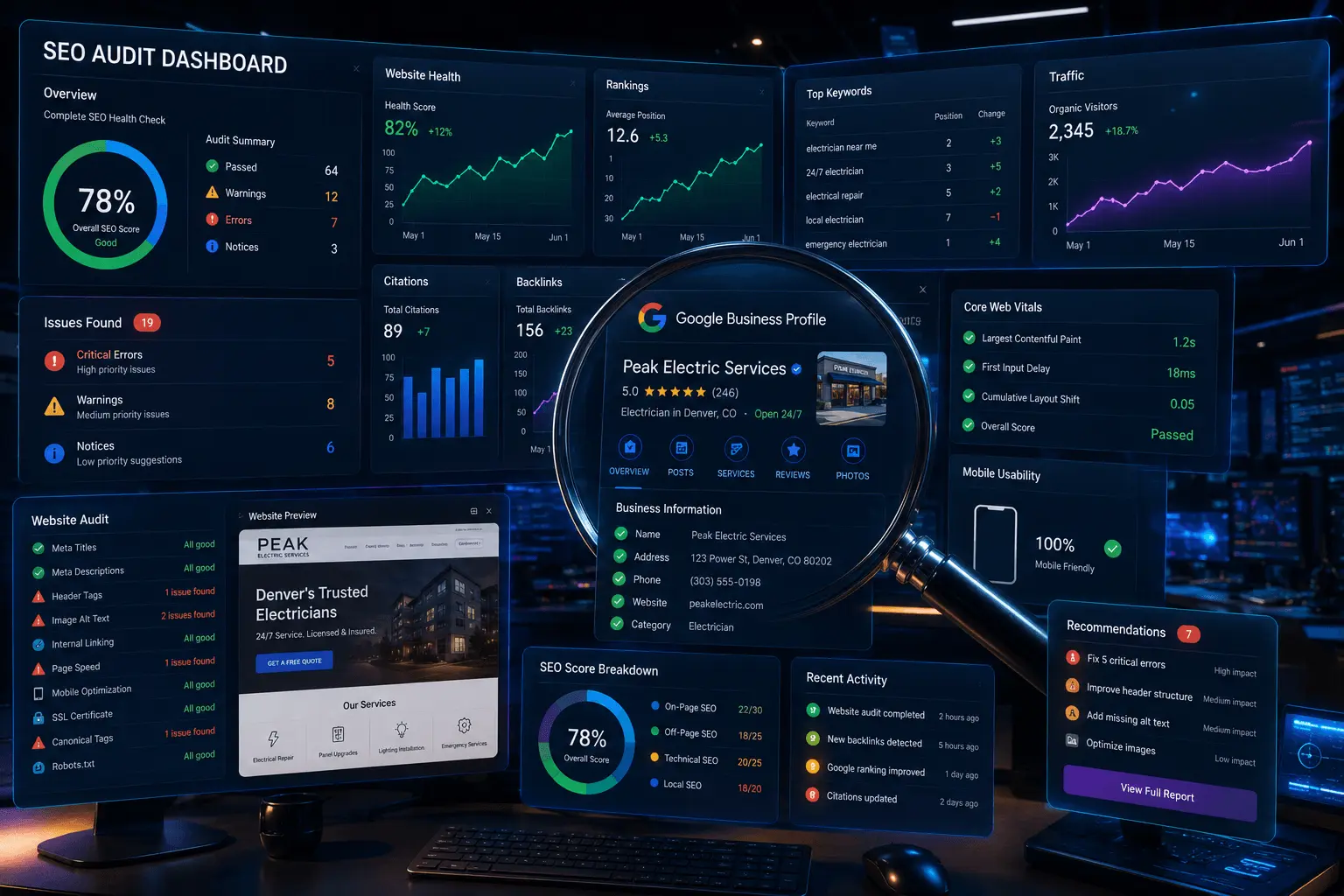
A local SEO audit is a full diagnostic of every factor that influences how your business ranks in local search. It tells you what is working, what is broken, and what your competitors are doing that you are not. Without one, you are essentially guessing at your SEO strategy.
What Exactly Is a Local SEO Audit?
A local SEO audit is a systematic review of all the elements that affect your visibility in local search results — your Google Business Profile, website on-page optimisation, citation consistency, review profile, backlink signals, and competitive positioning.
Think of it as a health check for your local search presence. Just like a doctor reviews multiple systems during a physical exam, a local SEO audit reviews multiple ranking signals to identify where you are strong and where you are losing ground. The goal is not just to find problems — it is to prioritise them.
Local SEO audits are different from general SEO audits. They specifically target the factors that influence your ranking in Google's local pack, Google Maps, and localised organic results.
Why Most Local Businesses Skip the Audit and Pay for It Later
What Is Actually Included in a Local SEO Audit?
Google Business Profile audit
Profile verification status, completeness, category selection, business description, photo quality and quantity, posting history, Q&A section, and attributes.
NAP consistency audit
Your Name, Address, and Phone Number must match exactly across every directory, aggregator, and platform. This scans for every inconsistency.
On-page website signals
Title tags, meta descriptions, header structure, local keyword usage, contact page format, location pages, and schema markup implementation.
Review profile assessment
Review quantity, recency, rating average, and response rate — benchmarked against your top three local competitors.
Local link building analysis
Backlinks from locally relevant and industry-relevant websites signal authority to Google. Compare your current backlink profile to top-ranking competitors.
Competitor analysis
GBP categories, citation volume, review counts, website structure, and content strategy of your top-ranking competitors.
Google Business Profile Audit: Where Most Audits Begin
- Category selection — choosing the wrong primary category, even slightly, can push you out of relevance for your core keywords
- Photos — businesses with more photos receive significantly more direction requests and website clicks
- Q&A section — most businesses have unanswered questions containing your target keywords sitting there for months
- Completeness score — every empty field is a missed ranking signal
Citation and NAP Audit: The Consistency Check
The citation audit maps your entire citation footprint. It identifies where you are listed, where you are missing from important directories, and where your information contains errors.
⚠️ Data aggregators deserve special attention. Platforms like Data Axle and Neustar Localeze push your business information to hundreds of downstream directories automatically. Errors at the aggregator level multiply across the entire citation ecosystem. Fix aggregator data first.
On-Page Local SEO Audit: What Your Website Is Telling Google
- Title tags should include your primary service and city — "Emergency Plumber in Seattle, WA" not "Home Services"
- Your contact page needs full NAP in plain text, not embedded in an image
- LocalBusiness schema markup tells Google your business name, address, phone, hours, and service area in machine-readable language
- Google cannot read text inside images — if your address is part of a graphic, Google cannot extract that information
Review and Reputation Audit: The Trust Signals Google Watches
The reputation audit benchmarks your review profile against your top three local competitors. If you have 40 reviews and your top competitor has 200, that gap is a ranking signal you need to close.
A business that earned 100 reviews two years ago and has not gotten a new one since sends a weaker signal compared to a business earning five new reviews per month consistently. Response rate is an underappreciated factor — checking your current response rate and patterns in unanswered reviews is a standard part of any good audit.
How Often Should You Run a Local SEO Audit?
For most local businesses, a full audit every six months is the right cadence. If you have recently moved locations, changed your phone number, rebranded, or added new service lines, run an audit immediately.
Between full audits, monitor your GBP Insights monthly. Watch for drops in search views, map views, or direction requests. These metrics often flag problems before they fully impact your rankings.
Should You DIY or Hire Someone for a Local SEO Audit?
- DIY is absolutely possible: BrightLocal, Moz Local, and Semrush's local toolkit give you the data you need
- Where professional audits earn their value: interpretation and prioritisation — knowing which three fixes will move your rankings the most
- Professional audit costs: typically $300–$1,500 depending on depth and number of locations
- Starting point for low-competition markets: BrightLocal's free trial + Google Search Console is a perfectly reasonable DIY approach
Frequently Asked Questions About Local SEO Audits
A regular SEO audit focuses on organic search performance across broad keyword categories. A local SEO audit specifically evaluates factors that influence visibility in local pack results, Google Maps, and geo-targeted searches — including GBP optimisation, citation consistency, and local link signals.
A basic DIY audit using tools like BrightLocal takes 2–4 hours. A professional comprehensive audit covering citations, on-page signals, GBP, reviews, and competitor analysis typically takes 1–2 weeks depending on the number of locations.
BrightLocal is the most complete option for local auditing. Google Search Console and GBP Insights are free and essential. Moz Local helps with citation analysis. Semrush and Ahrefs provide competitive and backlink data.
Professional local SEO audits typically range from $300 to $1,500 for a single location. Multi-location businesses or highly competitive markets can expect higher investment. Agencies often include audits as part of ongoing local SEO retainers.
No audit guarantees rankings. What it does is identify the specific barriers preventing better rankings and prioritise the fixes that carry the most impact. The audit is the diagnosis; implementation is the treatment.
Yes, and you should. Analysing your top-ranking competitors reveals what citation sources they use, how their GBP is structured, what categories they target, and what their review strategy looks like. This competitive intelligence is one of the most valuable parts of any local audit.
Want These Results for Your Business?
Get a free local SEO audit — I'll show you exactly what's holding your rankings back and the fastest path to the Map Pack.
🎯 Get Your Free SEO Audit