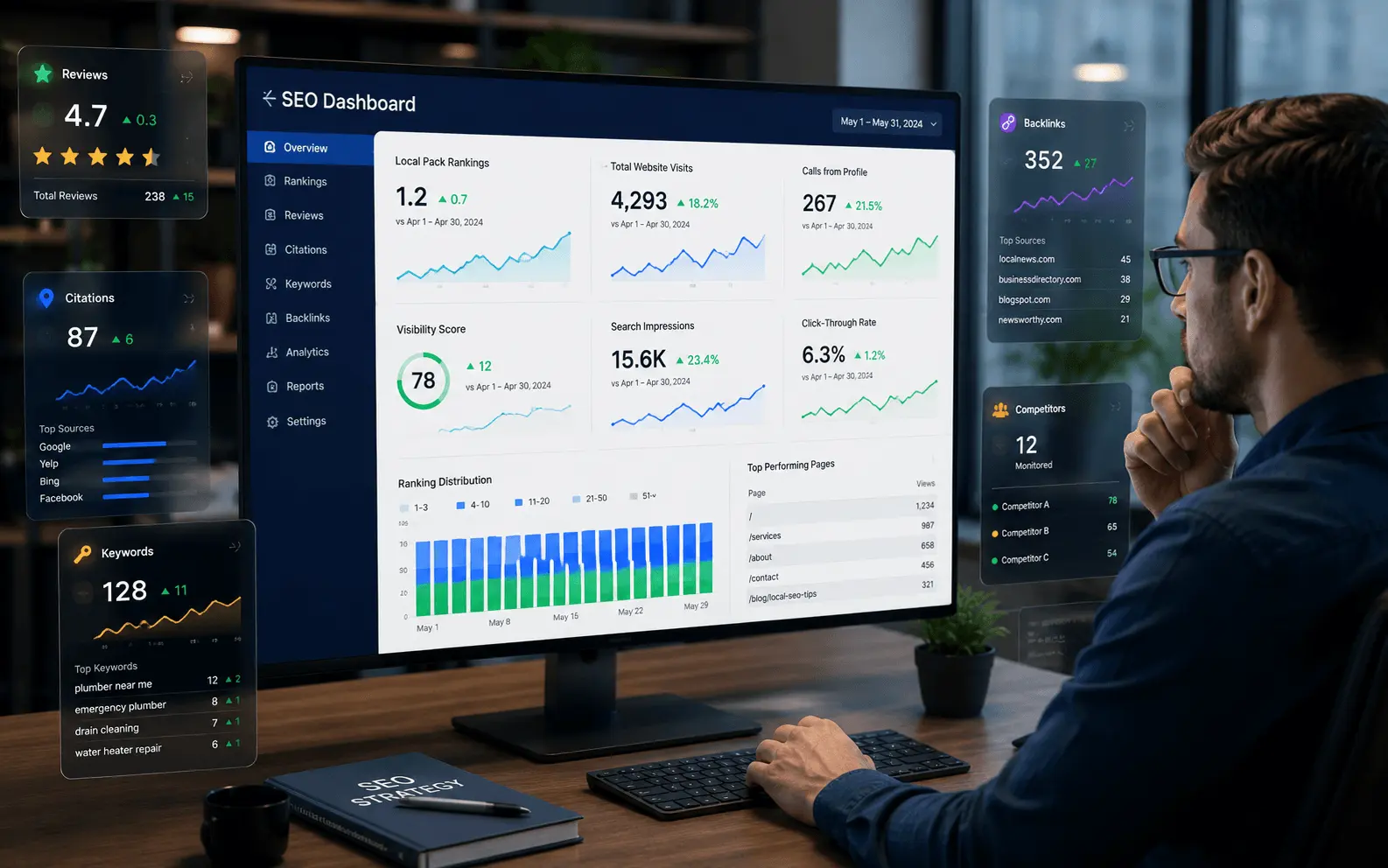
Why Most Businesses Are Optimizing for the Wrong Things
The local SEO space is full of advice that was accurate three years ago and is now only partially true. The Whitespark Local Search Ranking Factors Survey consistently reveals that the weight of individual signals shifts meaningfully from year to year. Businesses running on stale playbooks are competing at a disadvantage.
Google Maps ranking is not a single algorithm. It is three separate scoring systems — one for relevance, one for distance, one for prominence — that combine into a final ranking. A business can be strong on two pillars and still lose to a competitor that balances all three more effectively.
Google Business Profile Completeness and Accuracy Remains the Foundation
Primary category selection carries more ranking weight than almost any other individual profile decision. Research from Sterling Sky and Whitespark both confirm that the primary category is one of the strongest relevance signals Google uses to match a business to a search query.
- Primary category — most specific option for your core business, not "Contractor" or generic alternatives
- Services section — list every specific service with descriptions; Google uses this to match your profile to specific searches beyond your primary category
- Profile engagement signals — clicks to call, direction requests, website visits, and photo views are increasingly part of how Google evaluates relevance and popularity
Review Signals: Velocity Matters Far More Than Volume in 2026
A listing with 400 reviews and no new ones in six months tells a different story than a listing with 80 reviews and three or four new ones arriving every week. Google's current approach interprets consistent review generation as evidence that a business is actively operating and satisfying customers in the present.
When customers naturally mention specific services, neighborhood names, or descriptive terms in their reviews, those words contribute to the relevance signals of your listing. A review mentioning "emergency plumber in Naperville, fixed burst pipe same day" reinforces your relevance for those exact searches.
Proximity and Distance: The Factor You Cannot Fully Control But Can Influence
You cannot relocate your business to improve this signal, but you can influence how effectively Google understands and represents your service area.
- Clearly define service areas in your Google Business Profile settings
- Build location-specific pages on your website for every city and neighborhood you serve
- Earn citations on neighborhood-level and city-specific directories — they carry geographic specificity that national directories cannot replicate
Website Authority and Local Relevance Signals Are Increasingly Decisive
The connection between your website's local SEO strength and your Google Maps ranking has grown stronger with each major algorithm update. In 2026, businesses with locally optimized websites hold a meaningful ranking advantage even when their GBP is strong.
⚠️ Page experience signals are baseline, not differentiators. Core Web Vitals, mobile responsiveness, and load speed are expected in most markets. Failing them hurts you. Meeting them alone will not separate you from the pack.
Local link authority — links from locally and topically relevant sources — remains one of the most powerful and hardest to replicate ranking signals available. A backlink from your city's Chamber of Commerce, a regional news publication, or a local industry association carries more local ranking weight than dozens of low-authority directory links.
Behavioral Signals Are Playing a Larger Role Than Most Businesses Realize
Click-through rate from search results
A listing that earns clicks from a high percentage of people who see it tells Google it is compelling and relevant. Your business name, review count, star rating, and primary photo determine whether someone clicks you or moves past.
Direction requests and click-to-call actions
Both are tracked and factored into your listing's performance signals. A profile generating consistent engagement through these actions is evaluated more favorably than one that appears but drives little interaction.
Dwell time on your website
How long visitors spend on your site after arriving from Google feeds into behavioral quality signals. A website that answers questions thoroughly and keeps visitors engaged sends positive signals.
Citation Consistency: Still Foundational but No Longer Sufficient Alone
Citation building alone, without the stronger signals of reviews, behavioral engagement, and website authority, produces diminishing returns. The most effective citation strategy in 2026 focuses on quality and relevance over volume.
Ten highly authoritative, geographically and topically relevant citations contribute more to your ranking than 100 low-authority generic directory listings. Industry-specific directories, local business associations, and trade-specific platforms carry more signal weight than generic aggregators.
The Ranking Factor Most Businesses Are Completely Ignoring
Google Posts and profile activity have emerged as a more significant ranking signal than most businesses account for. Google's algorithm interprets consistent profile engagement as a quality signal about business relevance and operational status.
⚠️ Kevin's problem came down exactly to this. His competitor posted to Google twice a month, uploaded new job photos weekly, and had someone respond to every review within 24 hours. Kevin's profile had been untouched for eight months. Those activity signals were the deciding factor in a ranking battle where everything else was nearly equal.
Frequently Asked Questions
Based on current practitioner research and real-world testing, Google Business Profile completeness combined with review velocity is the highest-impact combination for most service businesses. A complete, active profile generating consistent fresh reviews outperforms competitors stronger in only one of those dimensions.
Indirectly. Your website's authority and local relevance contribute to your Maps ranking. Improving your website's organic signals through better local content and stronger backlinks will support your Maps position over time, though the relationship is indirect rather than a direct input.
Google makes changes frequently, with smaller adjustments happening continuously and larger named updates rolling out several times per year. The core ranking pillars of relevance, distance, and prominence have remained consistent, but the relative weight of signals within those pillars shifts with updates.
Yes, in most cases. Recovery requires identifying which signals weakened relative to newly elevated competitors and addressing those gaps specifically. The most common recovery paths involve improving review velocity, completing any profile gaps, and strengthening website local signals through new location pages or backlink acquisition.
No. Google has consistently confirmed that ad spend has no influence on organic Maps rankings. The two systems operate completely independently. A business spending zero on ads can outrank a competitor spending thousands per month.
Want These Results for Your Business?
Get a free local SEO audit — I'll show you exactly what's holding your rankings back and the fastest path to the Map Pack.
View Real Client Results