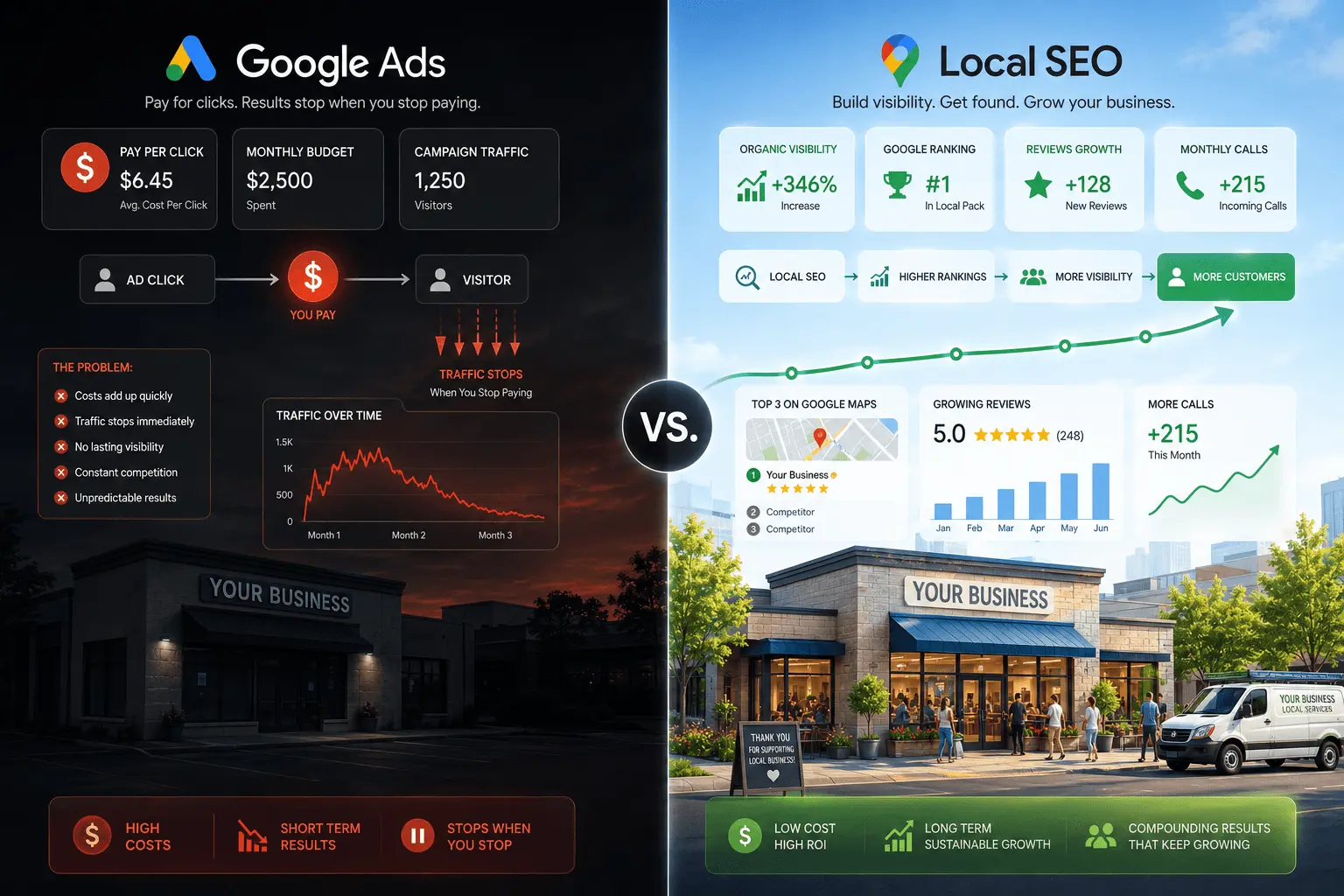
James switched his focus entirely to local SEO. Fourteen months later, his landscaping company sits in the top two Google Maps results for eleven search terms across his metro area. His cost per acquired customer dropped from over $600 to under $40.
Why This Decision Feels So Confusing for Service Business Owners
The confusion around local SEO versus Google Ads is not accidental. Google profits from ad spend, so the entire interface of Google Ads is designed to make running campaigns feel urgent and accessible. SEO agencies often oversell organic rankings as a magic solution that takes care of itself. Both sides have a financial incentive to push you toward their offering.
What changed in 2026 is the cost structure of Google Ads for service businesses. Average cost-per-click in competitive categories like HVAC, roofing, legal services, and home cleaning has increased dramatically. In many markets, a single click on a roofing keyword now costs between $35 and $90.
What Local SEO Actually Delivers for a Service Business
Local SEO is the process of optimising your online presence so Google confidently shows your business in the Local Pack. The core advantage: once your business ranks in the top three, you receive calls and booking enquiries without paying Google anything per click.
- Leads are free at the point of contact once ranked
- Builds compounding authority — each month of consistent effort makes your position stronger
- Each month of consistent effort makes your position harder for competitors to displace
- Organic results and map listings are trusted significantly more than paid ads by consumers
⚠️ The honest limitation: most service businesses see meaningful ranking movement within 60–90 days, but reaching the top three in a competitive market can take 4–8 months. If you need leads next week, local SEO alone will not solve that problem.
What Google Ads Actually Costs Service Businesses in 2026
In most mid-size to large markets, competitive service keywords cost between $15 and $90 per click. Industry data from WordStream suggests average landing page conversion rates of 3–6% for service businesses. That means for every 100 clicks you pay for, you might receive three to six actual enquiries.
At $30 per click, 100 clicks = $3,000 spend → ~4 leads. If you close half:
$1,500 per new customerbefore accounting for the cost of delivering the service.
For some service businesses with high average job values, that math works. A roofing company closing a $15,000 roof replacement from a $1,200 ad spend is happy. A cleaning company charging $150 per visit cannot make those numbers work sustainably.
Where Local SEO Wins Decisively in 2026
- Recurring/repeat-purchase services — cleaning, lawn care, pest control, pool maintenance: the compounding nature of local rankings makes SEO the stronger long-term investment by a wide margin
- Trust signals — consumers trust organic results and map listings significantly more than paid ads when choosing a local service provider
- Low-competition local markets — ranking organically can take as little as 60 days and generate leads for years at effectively zero ongoing cost
- Average job value under $500 — Google Ads will almost certainly cost more per customer than the job is worth
Where Google Ads Has a Real Advantage
- Emergency services — water damage restoration, locksmith, emergency HVAC: customers need someone right now and are willing to pay premium prices
- During a local SEO ramp-up — run a modest ad campaign while your organic rankings develop as a bridge of inbound leads
- Seasonal businesses — a gutter cleaning company that runs ads for 6 weeks in autumn then pauses can generate significant revenue without always-on campaigns
- Google Local Services Ads — charge per lead rather than per click, include a Google Guarantee badge, and often deliver better cost-per-lead performance
The Honest Answer: Which One Should You Choose First?
Established business playing a long game
Local SEO should be your primary channel. The compounding returns, zero per-lead cost at scale, and trust advantage make it the stronger foundation for sustainable growth.
New business needing revenue quickly
Run a targeted Google Ads or Local Services Ads campaign while simultaneously building your local SEO foundation. Use the ads as a bridge, not a permanent strategy. Set a 6-month budget ceiling.
High-ticket service (job value above $2,000)
Google Ads can work profitably alongside local SEO indefinitely. High-ticket businesses have the margin to absorb acquisition costs that would cripple a lower-ticket operator.
Lower-ticket service (job value under $500)
Google Ads in competitive markets will almost certainly cost more per customer than the job is worth. Local SEO is not optional for you. It is the only sustainable path to profitable growth through search.
How to Run Both Channels Without Wasting Your Budget
Treat local SEO as your foundation and Google Ads as a precision tool for specific situations. Invest in local SEO continuously. Use Google Ads selectively for high-value services not yet covered by organic rankings. Track both channels separately with clear cost-per-booked-job metrics.
Common Mistakes Service Businesses Make
⚠️ Treating Google Ads as a long-term strategy without building any organic presence is the most expensive mistake I see. Ad costs rise every year. An account that performs profitably today may not work in 18 months when competitors increase their bids.
- Abandoning Google Ads entirely before organic rankings are established — the transition should be gradual
- Measuring Google Ads by clicks or impressions instead of cost per booked job
- Assuming local SEO is free because you do not pay per click — it requires consistent time investment
Frequently Asked Questions
Yes, completely. Google Maps rankings are determined entirely by local SEO signals. Google Ads has no influence on organic Maps rankings whatsoever.
A meaningful test requires at least $1,500–$2,000 per month for most service categories in a mid-size market. High-competition categories like legal, HVAC, and roofing require minimums of $3,000 or more to be competitive.
Most service businesses see their first meaningful ranking improvements within 60–90 days of consistent optimisation. Reaching and holding a top three position in a competitive market typically takes 4–8 months.
No. Google has consistently confirmed that ad spend does not influence organic or Maps rankings. The two systems are entirely separate.
Running broad keyword campaigns without negative keyword lists. A roofing company running ads for 'roofing' without excluding 'roofing jobs' or 'DIY roofing' will waste a significant share of budget on clicks from people who have no intention of hiring anyone.
Want These Results for Your Business?
Get a free local SEO audit — I'll show you exactly what's holding your rankings back and the fastest path to the Map Pack.
🎯 Get Your Free SEO Audit