This story plays out in every industry and every market. Business owners invest in local SEO, see nothing for sixty or ninety days, conclude it is not working, and walk away right before the results arrive. Understanding why local SEO takes the time it does is the difference between winning and quitting at the worst possible moment.
Why Local SEO Does Not Produce Overnight Results
Local SEO is not like paid advertising, where money in equals visibility out from day one. It is a trust-building process. Google is deciding whether to recommend your business to its users. That decision takes evidence, and evidence takes time to accumulate.
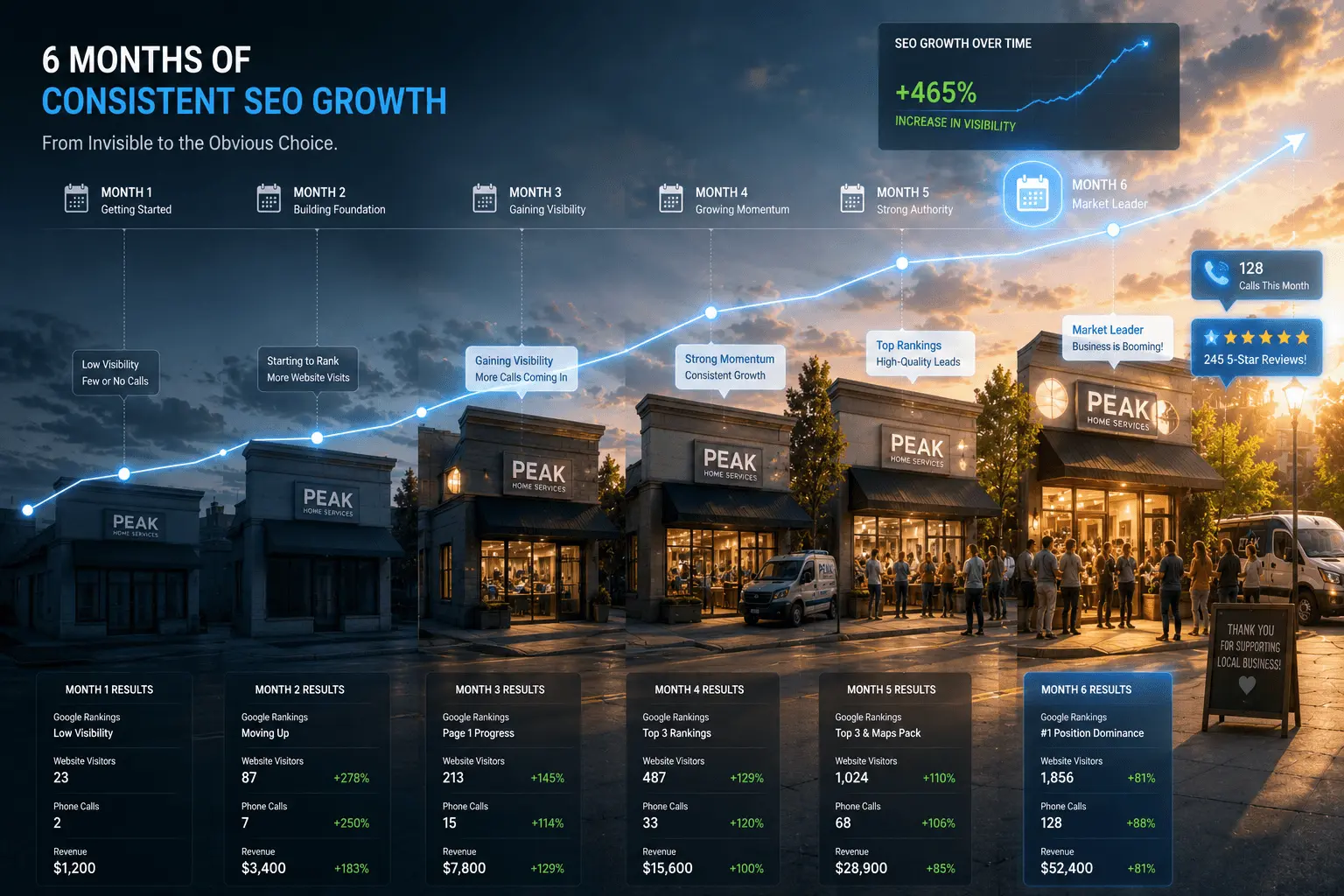
There is also a compounding dynamic at play. The first month produces very little visible movement. The second month builds on the first. By months four and five, the cumulative weight of consistent signals starts to tip the algorithm in your favour. Businesses that stay consistent for six months see dramatically better results than those that sprint for eight weeks and stop.
Month One: The Foundation You Will Not See but Cannot Skip
In the first month, almost nothing visible happens. Your rankings probably do not move. This is normal and it is not a sign that work is not being done. Month one is foundation work.
- Google Business Profile is claimed, verified, and fully completed with every category, service, attribute, and photo
- Existing citations are audited and inconsistencies corrected across all major directories
- Your website is reviewed for load speed, mobile usability, and consistent NAP
- This work is invisible to you but highly visible to Google — you are removing the obstacles actively holding you back
Month Two: First Signals and Small Movements
By month two, some of the foundation work begins to register. Google re-crawls your updated website. Citation corrections propagate across directories. Your GBP, now fully optimised and posting regularly, starts accumulating engagement data.
You may notice early ranking movement for less competitive long-tail searches. A chiropractor in a mid-sized town might appear for "back pain specialist [town]" before ranking for "chiropractor [town]." These early signals are meaningful even if they do not yet drive significant call volume.
Month Three: The Frustration Zone
⚠️ Month three is where most businesses give up — and where Rachel made her mistake. Rankings have moved a little but not dramatically. This is the period where impatient business owners start questioning the strategy.
Here is what is actually happening: Google has now crawled your updated site multiple times. Your posting schedule has established an activity pattern. Your early reviews have started building a velocity profile. The algorithm is accumulating evidence but has not yet reached the threshold where it significantly upgrades your position.
Think of a pot coming to the boil. The heat is real and the water is warming, but nothing visible happens until it suddenly does. Month three is the long stretch before the boil. The businesses that keep the heat on get there.
Months Four and Five: Rankings Start Moving
This is when local SEO starts to feel real. Service pages published in month two are now ranking for their target terms. GBP engagement has built up enough history to influence positioning. Review count and velocity are now meaningfully above competitors who are not running active campaigns.
For most local businesses in moderately competitive markets, months four and five bring the first meaningful Map Pack movement. The Leeds kitchen fitter I followed hit position three for their primary keyword at the start of month five. Call volume that month rose 34% compared to their pre-campaign average.
Month Six: When Local SEO Becomes a Genuine Business Asset
By month six, a well-executed local SEO campaign becomes a different kind of investment. Six months of consistent signals carry substantial cumulative weight. The businesses in the Map Pack at month six also begin seeing network effects: more visibility leads to more clicks, more calls, more reviews, and stronger rankings. The flywheel starts turning on its own.
For Rachel's physiotherapy clinic: she held a top three position for eight weeks, reviews had grown from 14 to 61, and her GBP was generating 42 calls per month directly, up from 7 when the campaign began.
How Business Type and Competition Level Affect Your Timeline
Competition level — the most significant variable
A landscaping company in a rural market might see Map Pack results in 60 days. Targeting a major city suburb with 30 active competitors means 6–9 months.
Starting condition
A business with a verified GBP, clean citations, and a website that just needs optimising will progress faster than one starting from scratch with citation errors and an unclaimed profile.
Review velocity
Businesses that systematically generate reviews move faster. In competitive markets, review count is often the tiebreaker between two equally optimised businesses.
Content investment
Businesses investing in genuine service and location-specific content consistently outperform those relying on profile optimisation alone.
Red Flags: When Your Campaign Is Actually Off Track
You are in months 1–3, your foundation work is documented, and your GBP shows regular posts and growing engagement. Subtle movement at this stage is normal.
⚠️ Walk away if: your agency guarantees Map Pack positions within 30 days, promises specific ranking positions, or refuses to explain what they are doing each month. Legitimate local SEO professionals talk openly about their process.
Frequently Asked Questions
Six months is a reasonable benchmark for meaningful results in most markets. Some businesses see movement earlier in low-competition areas. Highly competitive markets in major cities often require 9–12 months to reach and hold Map Pack positions consistently.
Ranking fluctuations are completely normal during an active campaign. Google continuously tests positions by temporarily moving listings up or down to measure click behaviour. A dip of one or two positions for a week is not a concern. A sustained drop over 4+ weeks warrants investigation.
You can handle foundational work yourself — GBP optimisation, citation building, and review generation are learnable without specialist help. Technical website work and content creation at scale are where professional support typically adds the most value.
Ask for a monthly activity report showing exactly what was completed — citation work logs, content published, reviews generated, GBP changes made, and ranking movement tracked over time. Vague reports are a serious warning sign.
Yes, but the core principles are the same. Service-area businesses cannot rely on storefront signals, so review velocity and GBP completeness carry even more weight. Content targeting specific service areas by name also matters more.
Want These Results for Your Business?
Get a free local SEO audit — I'll show you exactly what's holding your rankings back and the fastest path to the Map Pack.
🎯 Get Your Free SEO Audit