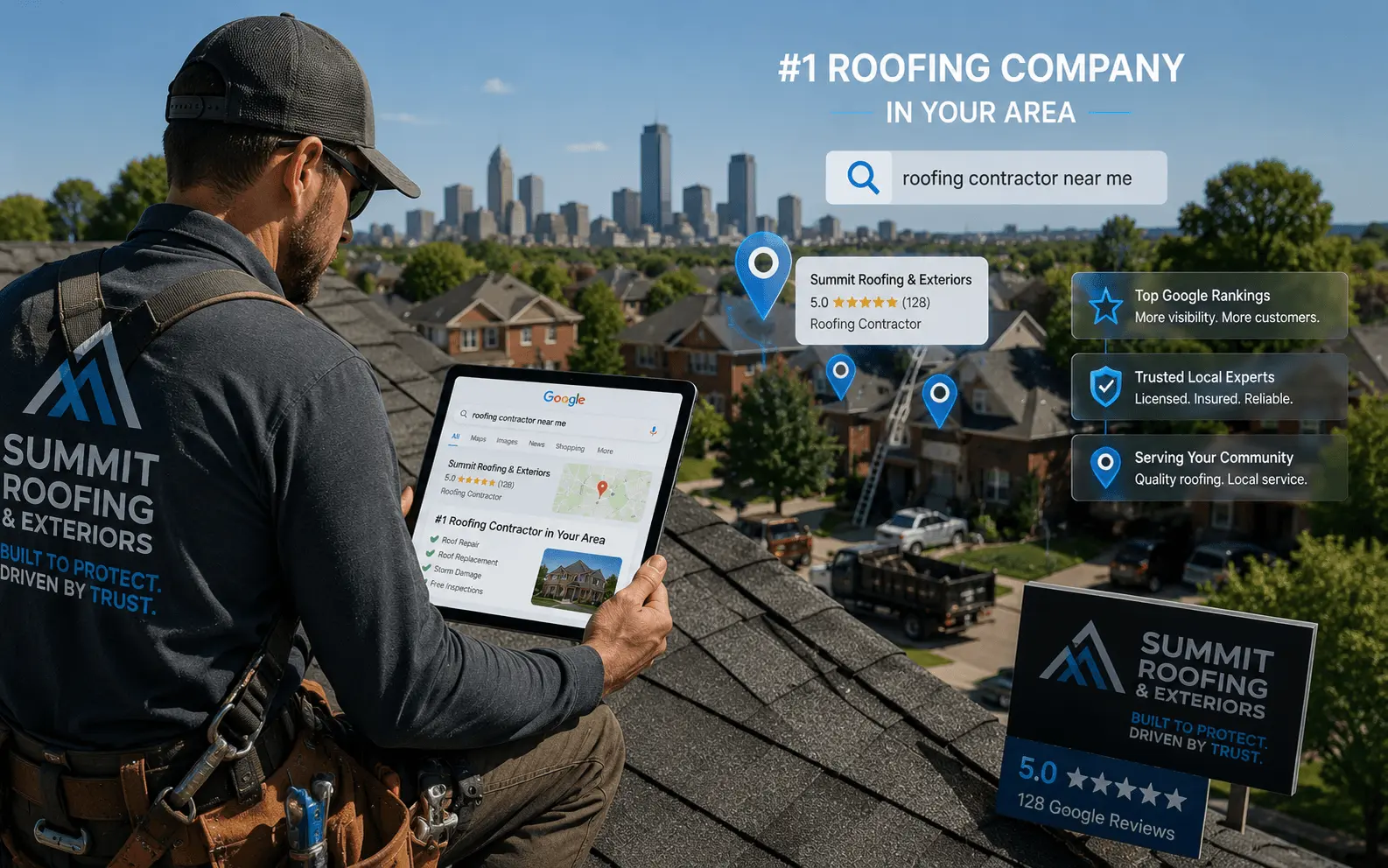
Why Roofing Companies Struggle to Rank on Google Maps
Roofing is one of the most competitive local search categories in the country. After every major storm, dozens of companies, many of them out-of-state storm chasers, flood into a market and aggressively pursue Google visibility. This creates a ranking environment more volatile and competitive than almost any other home service trade.
There is also a trust problem baked into the industry. Homeowners know roofing scams are common. They search carefully, read reviews thoroughly, and pay close attention to how established a company looks online. A sparse Google Business Profile with ten reviews and no recent activity looks like exactly the kind of operation a cautious homeowner avoids.
The companies dominating local Maps results have not necessarily been in business the longest. They have maintained the strongest online prominence signals — review volume, review recency, consistent citations, and active profile engagement — over time.
Your Google Business Profile Is Where Roofing Jobs Are Won and Lost
When a homeowner discovers a leak on a Tuesday morning and searches for a local roofer, they are not visiting five websites and comparing them carefully. They are looking at the Map Pack, reading the top two or three profiles, and calling within minutes. Your Google Business Profile is not a supporting tool. It is your primary sales asset for local search.
Set the right primary category
Your primary category should be "Roofing Contractor." Add secondary categories for every service you genuinely offer: "Gutter Cleaning Service," "Chimney Services," "Skylight Contractor," and "Siding Contractor" if applicable.
Make your services list exhaustive
Roof installation, roof repair, storm damage repair, flat roofing, shingle replacement, roof inspection, gutter installation, and fascia repair — list every service with a short description. Homeowners search for specific services, not just "roofer."
Write a trust-building description
Include how long you have operated, your service area, the types of roofing you specialise in, and certifications like GAF Master Elite or CertainTeed ShingleMaster. These details matter to a homeowner deciding who to trust with a $15,000 repair.
The Review Strategy That Fills a Roofer's Calendar
In roofing, reviews carry more weight than in almost any other trade. The average roofing job costs between $8,000 and $20,000. BrightLocal's research shows that 87% of consumers read online reviews for local service businesses and the average consumer reads ten reviews before trusting a business. For a high-ticket trade like roofing, that number is even higher.
Train your crew foreman to make a verbal ask at job completion. Then follow up within 48 hours with a text containing a direct review link. Companies using both steps together generate 2 to 3 times more reviews than those relying on the text alone.
⚠️ Review recency beats volume. A company with 400 reviews and none in the last three months is weaker than a competitor with 150 reviews and eight in the last thirty days. Build your system around consistent generation, not bursts.
Storm Season SEO: The Roofing Advantage Almost Nobody Uses
Post-storm local search volume spike
400% – 800%within 24 to 48 hours of a significant hail or wind event.
The roofing companies that capture those searches are not the ones who start optimising after the storm. They are the ones who prepared before storm season arrived.
- Build individual website pages targeting storm-specific searches BEFORE season: "storm damage roof repair [city]," "hail damage roofer [city]," "emergency roof repair [city]"
- Pages that have existed for two to three months rank far faster in a post-storm search surge than pages created the day after
- Update your GBP posts the moment a significant weather event is reported in your area — same-day storm damage assessment posts capture real-time search intent
Publish storm damage pages in January and February so they are indexed and aged by April–June hail season in most US markets. Do not wait for the storm to start optimizing.
Local Keywords That Bring In High-Value Roofing Jobs
Intent-based service pages
A page titled "Roof Replacement in [City]: What It Costs and What to Expect" that genuinely answers homeowner questions will consistently outperform a generic homepage targeting "roofer [city]."
Manufacturer certification searches
GAF certified roofer [city] and CertainTeed contractor [city] represent searches from homeowners who already know what they want. Competition for these searches is dramatically lower than for broad roofing terms, and the homeowners searching them typically pursue larger jobs.
Use Google autocomplete for your specific market
Type "roof repair [your city]" and note every suggestion. Those are real searches your potential customers are making right now — each one is a potential service page.
Citations and Local Authority: Building Trust With Google
The most common citation problem roofing companies face is history. Many businesses have moved locations, changed phone numbers, or rebranded. Every old detail still on directories is an active negative signal.
- Audit and correct every existing citation using BrightLocal or Moz Local before building new ones
- Beyond general directories, prioritise industry-specific citations: NRCA (National Roofing Contractors Association) directory, manufacturer contractor locators for GAF, Owens Corning, and CertainTeed
- A clean, consistent citation profile across 30 to 40 quality sources takes 6 to 8 hours to build and maintains its ranking value for years
Frequently Asked Questions
Roofing is among the most competitive local search categories because job values are high and storm chasers temporarily flood markets after weather events. That said, permanent local companies maintaining consistent SEO signals year-round consistently outrank seasonal competitors within two to three months of a storm passing through.
No. You need one verified profile for your business address. Add up to 20 service areas covering every city and suburb where you genuinely work. For ranking in specific cities beyond your main location, create dedicated city service pages on your website targeting those areas with genuine, useful content.
In mid-sized markets with moderate competition, most roofing companies see Map Pack movement within 60 to 90 days of consistent work. Ranking in the top three in a major metro typically takes five to eight months. The variables are your starting review count, citation cleanliness, and how active your competitors are.
Always. In roofing more than most trades, your response to a difficult review is scrutinised heavily by potential customers who understand the industry's reputation. A calm, factual response that acknowledges the concern and explains what was done to resolve it builds more trust than a page of perfect reviews.
Combine an in-person ask at job completion with a direct review link text within 48 hours. Add the review link to your invoice and post-job follow-up communications. Businesses using all three touchpoints consistently generate four to five times more reviews than those using just one.
Want These Results for Your Business?
Get a free local SEO audit — I'll show you exactly what's holding your rankings back and the fastest path to the Map Pack.
View Real Client Results