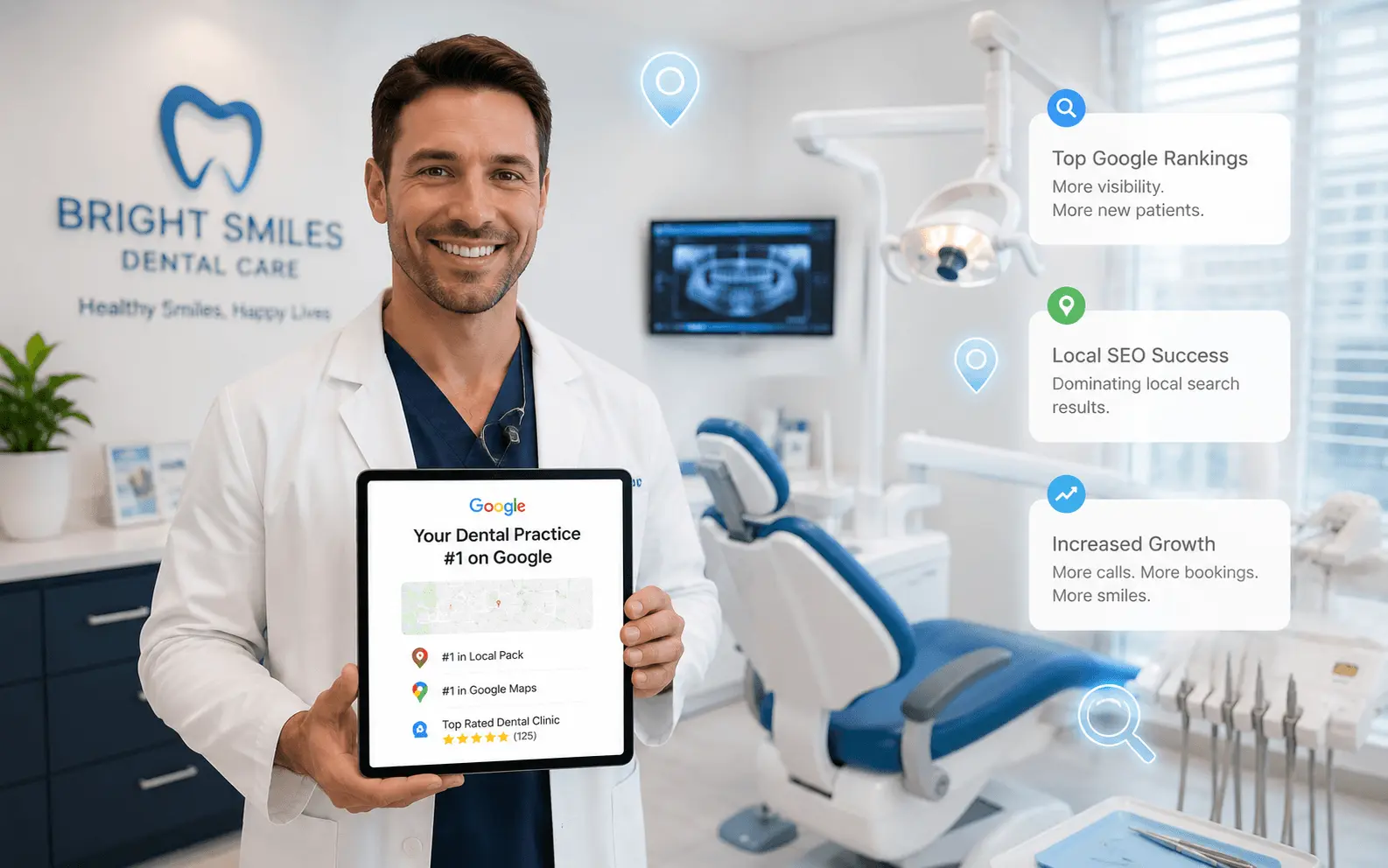
Why Google Has Become the Front Door of Every Dental Practice
When a family moves to a new neighborhood, the first thing they do to find a dentist is open Google and type "dentist near me." That moment of search intent is the most valuable opportunity a dental practice can capture because the person searching is already decided — they need a dentist and they are ready to book.
Lifetime value of a single new dental patient
$5,000 – $15,000+in routine care and restorative work over 10 years.
Research from BrightLocal shows over 80% of people searching for a local dentist use Google as their primary discovery tool, and the top three Local Pack positions capture the overwhelming majority of clicks and calls.
Step 1: Claim and Optimize Your Google Business Profile Completely
Choose "Dentist" as your primary category
Then add secondary categories for specialty services — cosmetic dentistry, pediatric dentistry, orthodontics, oral surgery, dental implants each have their own GBP categories.
Fill out every section without exception
Hours, phone, website, and crucially your services section with individual descriptions for each treatment. Practices completing their services section rank for a broader range of treatment-specific searches.
Write a compelling practice description
Naturally include your city name, core services, and distinctive qualities. Mention whether you welcome new patients, accept specific insurance plans, offer same-day emergency appointments, or provide sedation dentistry.
Upload minimum 30 high-quality photos
Reception area, treatment rooms, team at work, sterilization equipment, and before/after treatment photos with patient consent. Dental practices with rich photo libraries consistently outperform competitors with few or no images.
Step 2: Understand Why NAP Consistency Is Non-Negotiable for Dental Practices
Dental practices face a specific NAP challenge. Healthcare directories like Healthgrades, Zocdoc, WebMD, Vitals, and RateMDs often create listings automatically using data pulled from insurance networks and licensing boards — frequently containing outdated addresses, wrong phone numbers, and name variations.
⚠️ Priority dental and healthcare citation sources: Healthgrades, Zocdoc, WebMD, Vitals, RateMDs, Yelp, the American Dental Association's Find-a-Dentist directory, your state dental association directory, Bing Places, and Apple Maps. Inconsistent info on any of these weakens your overall local authority.
Step 3: Build a Review Generation System That Runs Without Your Attention
The most common mistake dental practices make with reviews is treating them as something that happens naturally when patients feel moved to write one. That passive approach produces slow, inconsistent growth that leaves you permanently behind competitors who ask systematically.
Build review requests into your post-appointment workflow
After a completed appointment, your front desk or practice management software should trigger a text with a direct link to your Google review page.
Time your ask correctly
Ask when the patient is happy — right after a positive appointment, not a week later. Dental practices using Dentrix or Eaglesoft can automate this through simple integrations.
Respond to every review professionally
For positive reviews, write specific responses without disclosing protected health information. For negative reviews, respond professionally and invite the patient to contact your office directly. Always stay HIPAA-compliant.
Dr. Priya's practice implemented post-appointment automated texts through Dentrix. In four months, her review count grew from 11 to 97. Her average rating moved from 3.9 to 4.7.
Step 4: Optimize Your Practice Website for Local Search Signals
- Create individual service pages for each treatment — dental implants, Invisalign, teeth whitening, pediatric dentistry, emergency dental care each deserve their own dedicated page
- Build location pages if your practice serves patients from multiple cities or neighborhoods
- Place full practice name, address, and phone in the footer of every page — in text, not images
- Add local business schema and medical practice schema so Google can read your practice type, location, hours, and services
- Embed a Google Map on your contact page
Step 5: Build Local Backlinks That Establish Your Practice as a Community Anchor
Sponsor local school health fairs or community wellness events
Ask for a link from the event website. Even small sponsorships produce permanent locally-relevant backlinks.
Partner with local pediatricians, orthodontists, or oral surgeons
Request that they mention your practice on their patient resources page with a link. This builds referral traffic and local SEO authority simultaneously.
Contribute expert articles to local parenting blogs or neighborhood publications
Offer to write on topics like children's dental health, fluoride safety, or what to do in a dental emergency.
Step 6: Keep Your Profile Active With Posts, Updates, and Q&A Content
- Use Google Posts to share practice updates at least twice a month — new patients accepted, financing options, seasonal reminders
- Populate your Q&A section with answers to common questions — insurance accepted, first visit expectations, emergency hours, patient age for first appointment
- Add new photos weekly — Google rewards active profiles with stronger visibility
The HIPAA Consideration Most Dental SEO Guides Skip
⚠️ HIPAA and Google Reviews: When responding to reviews, never reference any clinical details, appointment information, or anything that could confirm the reviewer is a patient of your practice — even thanking someone for mentioning a specific procedure can constitute a HIPAA violation. Keep all review responses warm, professional, and generic. Run your response approach past your compliance advisor if uncertain about specific language.
Common Mistakes Dental Practices Make With Local SEO
- Claiming GBP and handing it to a front desk team member with no training or system for maintaining it — profiles require consistent monthly attention
- Using stock photos of smiling models instead of real photos of your actual team and office — creates a credibility gap patients sense immediately
- Ignoring Healthgrades and Zocdoc — these healthcare directories directly influence how Google perceives your practice's prominence and trustworthiness
- Waiting for patients to leave reviews without ever asking — the single most common reason practices with excellent patient satisfaction have thin review profiles
Frequently Asked Questions
Most practices see meaningful ranking movement within 60 to 90 days of consistent optimization work. Reaching and holding the top three in a competitive suburban or metro market typically takes four to seven months.
No. A dental practice should have one Google Business Profile for the practice itself, not individual profiles for each dentist. Individual provider profiles create NAP confusion, split review authority, and can violate Google's duplicate listing policies.
Yes, indirectly. Listings on insurance network directories like those maintained by Delta Dental, Cigna, and Aetna contribute to your overall citation footprint and add to Google's confidence in your practice's legitimacy.
Respond professionally without confirming or denying the person is a patient — that would risk a HIPAA issue. Note that you cannot locate a matching record and invite them to contact your office directly. Then flag the review through your GBP dashboard for potential removal.
For most single-location practices, the foundational work — GBP optimization, citation management, review generation, and basic website updates — can be handled in-house with training. Agency investment becomes worthwhile in highly competitive metro markets or multi-location groups where consistent execution at scale is difficult to maintain internally.
Want These Results for Your Business?
Get a free local SEO audit — I'll show you exactly what's holding your rankings back and the fastest path to the Map Pack.
View Real Client Results